Most Engineers Are Never Taught How to Interview. Here's the Cost.
What separates interviewers who extract real signal from those who reject great candidates - covering prep, problem design, bias, and debrief | TopHire.co
What separates interviewers who extract real signal from those who reject great candidates - covering prep, problem design, bias, and debrief | TopHire.co
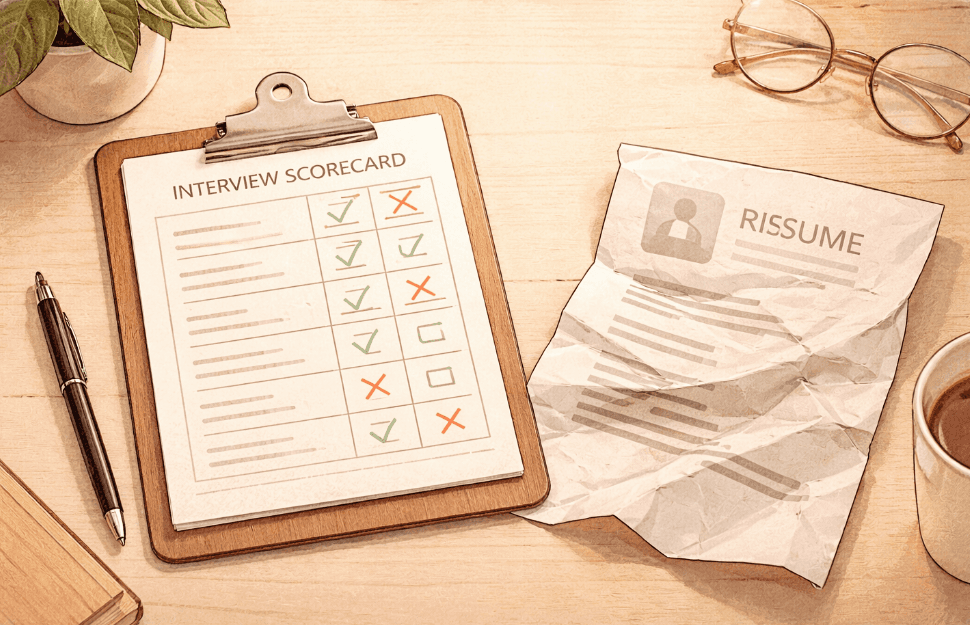
Most engineers are never taught how to interview. One day, your manager says, "We need you to interview this candidate on Thursday," hands you a resume, and that's it. I've collected feedback from thousands of candidates. The pattern is clear: the quality of the interviewer matters as much as the quality of the candidate.
Spending 5 minutes with the candidate's resume before the interview changes everything. I've heard candidates say: "The interviewer asked me to introduce myself, and when I mentioned my current company, they said, 'Oh, what does that company do?' It was on the first line of my resume."
Before the interview starts, be clear on what you're testing. You can't test everything in 60 minutes, so pick 1–2 areas and go deep. If you're in the second round and the first round already tested coding, don't test coding again.
The purpose is to see if the candidate can write working code under moderate pressure. Good problems: a competent engineer can reach a working solution in 30–40 minutes. Bad problems: obscure dynamic programming variants, math-heavy problems, anything where the "trick" is the entire solution.
Silence is okay. When a candidate pauses for 30 seconds, they're thinking. Don't fill the silence with hints. If 2–3 minutes pass with no progress, offer a nudge — not the answer. "What data structure might help you look things up quickly?" is a nudge.
A candidate who talks through their approach, considers edge cases, and codes it cleanly — that's a hire, even if they need a hint. A candidate who jumps straight to code, writes something that works, but can't explain why — that's a concern.
"Design Twitter" and "Design a URL shortener" are so commonly practised that you're testing preparation, not design ability. Better: describe a real problem your team faced.
There's no right answer in system design. Push the candidate to articulate trade-offs. The candidates who impress aren't the ones who draw the most boxes — they're the ones who can tell you what breaks and why.
The "like me" bias: you naturally favour candidates who remind you of yourself
The halo effect: a Google resume doesn't guarantee brilliance, a TCS resume doesn't mean mediocre
The "great communicator" trap: don't confuse articulation with ability
The "difficult question" bias: if only 1 in 10 candidates can solve it, you're testing recall, not ability
Not tomorrow. Immediately after the interview ends. Your impressions are freshest in the first 10–15 minutes. Structure: what was the question, how the candidate approached it, what went well, what didn't, and your overall recommendation.
An otherwise strong candidate who stumbles on one question shouldn't be rejected because of it. Some of the best engineers I know would fail a surprise DP question on a bad day.
The best answer I've heard to "What are you looking for? Can this person, in 3–6 months, independently own a significant piece of our system and make it better?"
That's the question. Everything in the interview is trying to answer that.