A Bad Hire Didn't Cost You 3x Their Salary. It Cost You More.
A real breakdown of what a mis-hire actually costs - direct, indirect, and the expensive ones you never trace back to one decision | TopHire.co
A real breakdown of what a mis-hire actually costs - direct, indirect, and the expensive ones you never trace back to one decision | TopHire.co
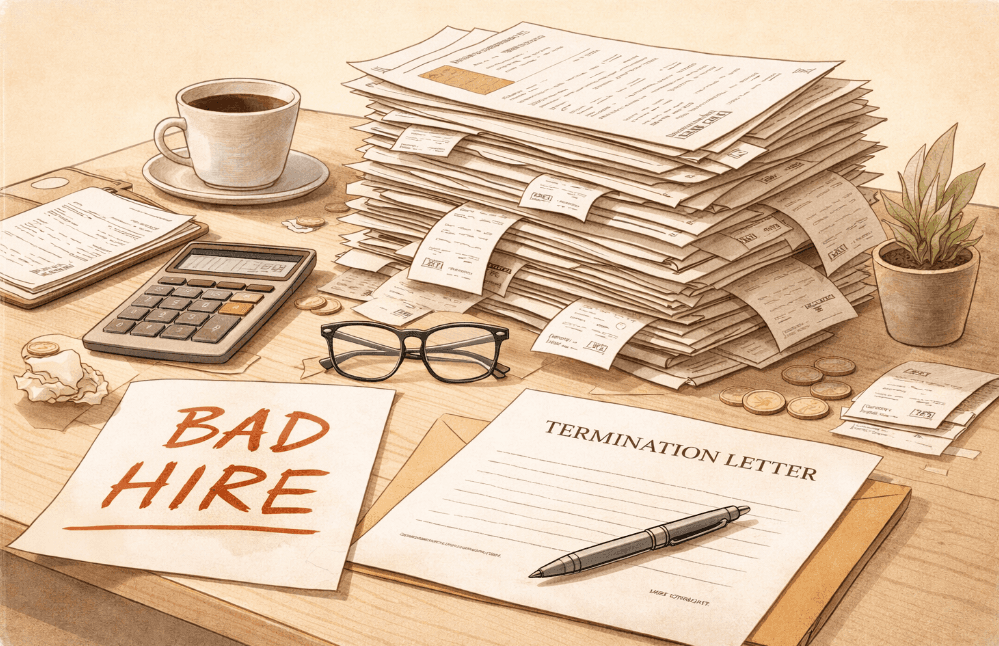
Everyone quotes the stat: "a bad hire costs 3–5x their annual salary." The answer is that nobody has a precise number because the cost depends entirely on context. But I can tell you what I've seen happen, and the costs are real.
A client hired a senior backend engineer at 32L CTC. Three months in, the engineering manager realised the person couldn't work independently. Their code required extensive review, and they were resistant to feedback. By month 7, they mutually agreed to part ways.
7 months of salary: roughly 18.7L
Recruiter fee: 3.2L
Laptop, equipment, onboarding: ~50K
Severance (1 month): 2.7L
Total direct: ~25L
6 interviewers x 1.5 hours each: 9 person-hours of interviewer time
Engineering manager time on performance conversations: ~30 hours over 3 months
Code that needs to be rewritten: 2–3 weeks of another engineer's time
Team morale: One team member later cited this as a factor in exploring other opportunities
Time to re-hire: another 6–8 weeks
Total cost: easily 40–50L for a 32L hire. And that's a relatively contained bad hire - the person wasn't toxic, just underperforming.
The expensive bad hires are the ones who can do the work but destroy the team. The brilliant engineer who belittles junior team members. The tech lead who plays politics. These people pass interviews with flying colours. The cost shows up as attrition - when your best engineers start leaving, the connection to one bad hire is rarely obvious in the moment.
The role has been open for 3 months. The manager takes the next person who clears a minimum bar. Desperation is the enemy of good hiring.
The interview tests for things that don't predict job performance. Solving a graph theory problem tells you nothing about whether someone can debug a production issue at midnight.
I'm amazed at how many companies skip reference checks. A 15-minute call to a previous manager would have surfaced the problem in at least half the bad hires I've seen. "Would you hire this person again?" is the only question that matters.
An IIT degree and 3 years at Amazon look great on paper. But some of those engineers maintained a low-priority internal tool. Dig into what they actually did, not where they did it.
Move slowly when you can afford to - an empty seat for an extra month is almost always less costly than a bad hire
Use paid work trials for senior roles (1–2 week engagements on real, self-contained problems)
Check references properly - ask specific questions about where they struggled and how they handled disagreements
Have multiple interviewers debrief independently before discussing
Have a structured 90-day onboarding with 30/60/90 check-ins
The cost is higher than any bad hire: the good candidate you didn't hire because your process filtered them out. You'll never know the cost of the people you turned away. But it's there, and it's probably higher than you think.